
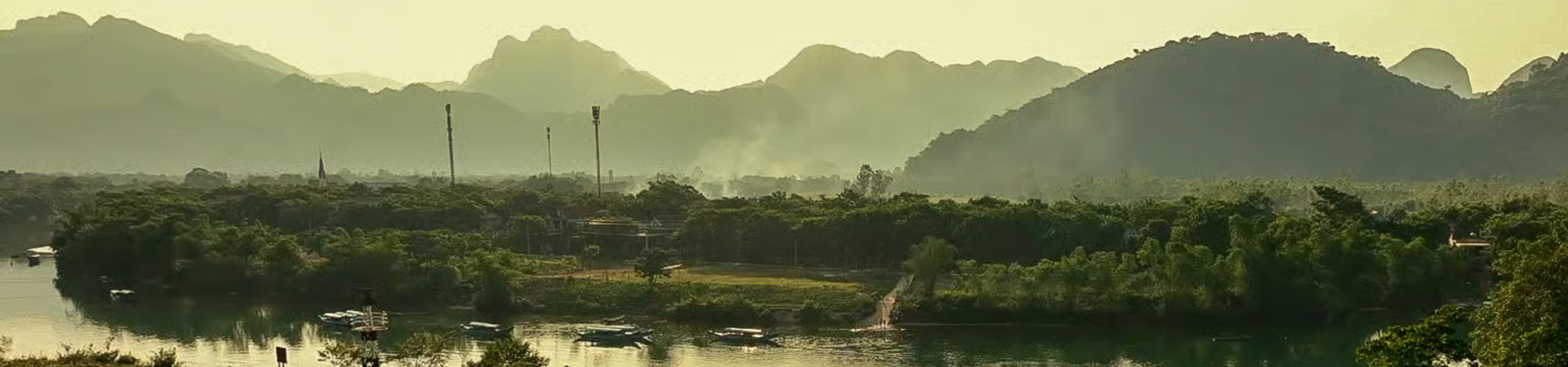
Amidst the majestic Trường Sơn mountain range, where vast primeval forests embrace one of the world's most spectacular cave systems, forest patrol and protection work in Phong Nha – Ke Bang National Park holds immense importance.
It's not just a regular activity to preserve natural resources and biodiversity, but also a sacred duty for those who are tirelessly safeguarding the "green lungs" of Central Vietnam – a UNESCO World Heritage site.
Faced with challenges such as illegal logging, wildlife poaching, forest fires, and climate change, forest patrol is considered the first line of defense, playing a crucial role in the National Park's long-term conservation strategy.
The force responsible for forest patrol in Phong Nha – Ke Bang comprises several components:
- Dedicated forest rangers from the National Park Management Board;
- Local forest protection teams at stations and checkpoints in the core and buffer zones;
- Local community forces – people who live near the forest, understand it, and consider it an integral part of their lives.
They are the unsung heroes, working in rugged terrain and harsh weather conditions, frequently crossing streams and traversing forests, facing numerous risks to protect every inch of forest and every stream.
Many forest rangers have dedicated their entire lives to this work, considering each patrol a part of their mission to protect humanity's shared heritage.

Forest patrols in Phong Nha – Ke Bang are conducted according to a regular monthly plan and on an ad hoc basis when violations are detected. Patrol teams operate on land, rivers, and deep forest roads, covering the entire core area of over 123,000 hectares.
In addition to using traditional topographic maps, GPS, and compasses, the patrol force is now equipped with SMART (Spatial Monitoring and Reporting Tool) data recording devices, which help store, manage, and analyze information collected from the field.
Camera traps, drones, and GIS applications are also used to detect early signs of forest encroachment or illegal hunting of wildlife.
The combination of the practical experience of the forest rangers and modern technology has made patrols more effective, accurate, and timely.

Forest protection cannot be solely the responsibility of forest rangers. In Phong Nha – Ke Bang, patrols are carried out with close coordination among many parties:
Police, border guards, local authorities,
International conservation organizations such as WWF, GIZ, Fauna & Flora International (FFI),
Buffer zone residents, and ecotourism businesses.
This cooperation creates a comprehensive forest protection network, ensuring both effective control and enhanced community awareness. Training programs, forestry law awareness campaigns, and environmental education are regularly organized to help people better understand the role of forests and voluntarily participate in protection efforts.

In the coming period, the National Park Management Board will continue to apply modern monitoring technology, expand the model of co-management of forests with local communities, and strengthen international cooperation to enhance forest protection capacity and natural resource management.
The goal is to build a sustainable conservation model in which humans and nature coexist harmoniously – so that the green of Phong Nha – Ke Bang will endure forever.
“In the vast forests of Phong Nha – Ke Bang, each patrol's footsteps still echo in the silence of the deep forest.
Each journey is not just a task, but a commitment – to protect the forest, to protect the source of life, to protect the soul of the heritage.”
Share this article